


What’s Actually Inside Most Furniture
Most furniture sold at everyday price points is built from MDF or particle board — engineered wood products bonded with urea-formaldehyde resin. Formaldehyde is a known human carcinogen. It doesn’t stay locked inside the material. It off-gases continuously at room temperature, for years after the piece was made, and the rate climbs with heat and humidity.
The VOCs — volatile organic compounds including benzene and toluene — come from the lacquers and synthetic finishes applied to the surface. Some are relatively harmless. Others are linked to respiratory and neurological effects with prolonged exposure.
Here’s what catches most people off guard: that “new furniture smell” is formaldehyde and VOC off-gassing. It fades from awareness before it stops occurring. The furniture industry has no legal obligation to tell you any of this — a piece can be labeled “wood furniture” while being made entirely from formaldehyde-saturated particle board.
The Two Rooms That Deserve the Most Attention
Bedrooms come first. You spend seven to nine hours there every night, in a closed room, breathing air that circulates around whatever your furniture is made from. That’s not occasional exposure — it’s continuous, nightly, for years.
A non toxic bed frame built from solid hardwood with a formaldehyde-free finish eliminates that variable entirely. No resin binders. No synthetic coatings off-gassing while you sleep. For children especially — whose lungs and immune systems are still developing — american made bedroom furniture built to a clean material standard isn’t a luxury. It’s the baseline worth holding to.
Dining rooms matter differently. You’re not there for eight hours, but children sit close to the table surface for extended periods, often at floor level where heavier particles settle. A french country dining room table
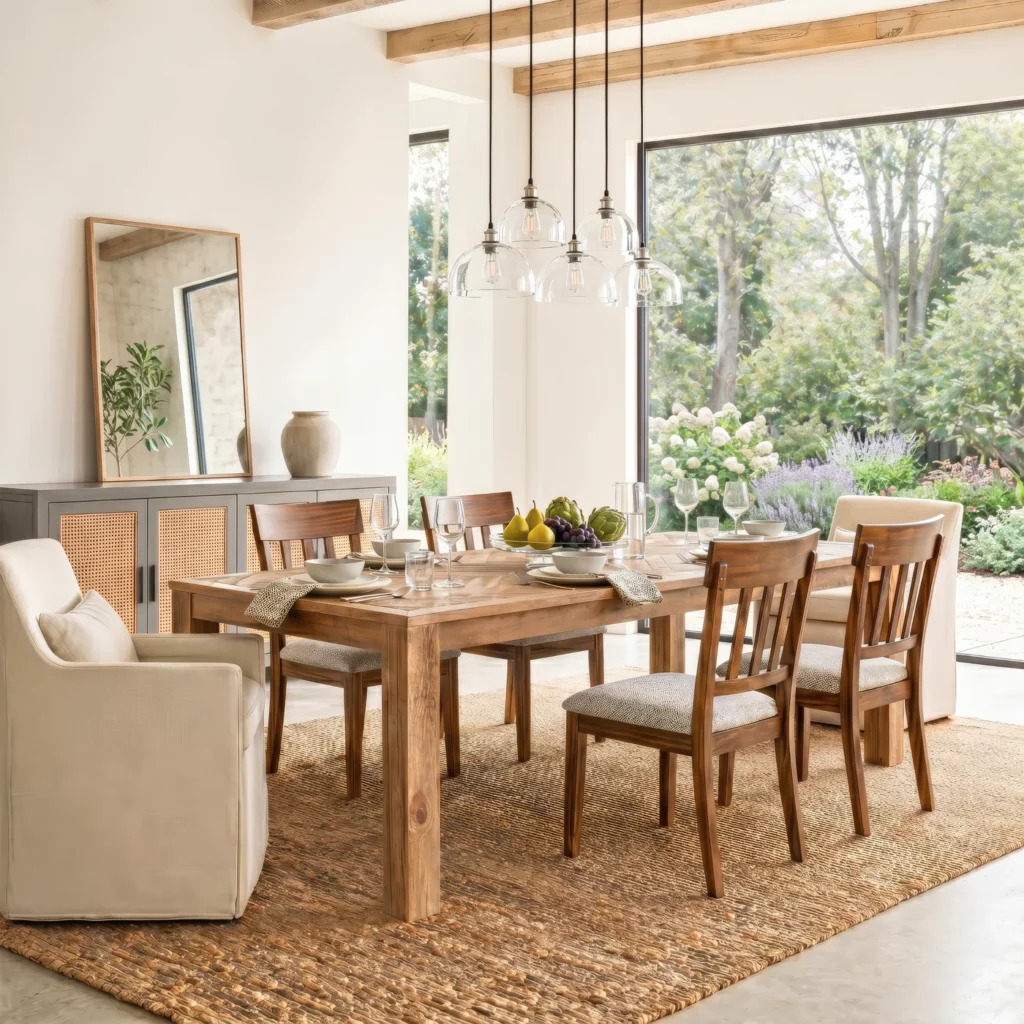
built from solid oak or walnut — properly kiln-dried, finished with hardwax oil or a water-based coating — brings the warmth and character the style is known for, with none of the chemical tradeoffs a flat-pack alternative brings into your home.
The best wood for a dining table is solid hardwood. Not because it photographs better. Because it doesn’t need resin to hold together.
What Non Toxic Actually Means
Two things define a genuinely non toxic piece: the core material and the finish.
The material should be solid hardwood throughout. Not “solid wood construction” — a phrase that legally permits MDF panels inside a solid wood frame. Not “engineered wood” — a polished term for compressed fiber bonded with resin. Solid hardwood is cut directly from timber, kiln-dried to the right moisture content, and held together with traditional joinery. No chemistry required to make it structurally sound.
The finish should be water-based or hardwax oil. These sit at the low end of VOC output. Hardwax oil penetrates the wood surface rather than sitting on top of it, which means it doesn’t crack, peel, or trap compounds against the material over time.
Formaldehyde free furniture solves one part of the problem. Non toxic furniture solves both. A piece can skip the urea-formaldehyde resin and still carry a VOC-heavy lacquer finish — which is why both material and finish need to meet the standard.
Conclusion
The furniture in your home is either working for your family or quietly working against them. Non toxic furniture built from solid hardwood removes that question from the equation — and the pieces built to that standard are ones you buy once, place in your home, and stop thinking about entirely.