


Choosing the right material for your commercial kitchen floor means understanding how each option actually performs under real kitchen conditions, not just how it looks in a product brochure. Food service operators in New Jersey have several flooring options presented to them by contractors and suppliers. Some of those options are genuinely suitable for a commercial kitchen. Others seem practical on paper but fall apart quickly once they meet the realities of daily kitchen use.
How Does Tile Perform in a Commercial Kitchen?
Tile is the most traditional choice for commercial kitchen floors, and there are historical reasons for that. Ceramic and quarry tile are durable materials, resistant to many forms of damage, and easy to replace one piece at a time when individual tiles crack. But the traditional tile-and-grout approach has a fundamental design flaw that becomes increasingly problematic in a commercial kitchen environment over time.
The problem isn’t the tile. It’s the grout. Grout is inherently porous and absorbs bacteria, grease, moisture, and food particles regardless of how aggressively it’s cleaned. Under thermal stress from cooking operations, grout cracks. When it cracks, it creates pathways for moisture to reach the substrate below the tile, which eventually compromises the adhesion of the tile itself. Cracked grout also creates trip hazards as tiles shift and edges become uneven. For any operator seriously evaluating commercial kitchen flooring solutions, the grout problem is the reason tile keeps falling short of what a professional kitchen actually needs.
What About Vinyl Sheet Flooring?
Vinyl sheet flooring is often marketed to smaller food service operations as a cost-effective alternative to tile. It installs faster, has no grout joints, and comes in a variety of designs. Under light commercial use, it can perform adequately for a few years. Under real commercial kitchen conditions, it typically doesn’t.
The core problem with vinyl sheet flooring in a commercial kitchen is that it isn’t designed for the thermal and chemical exposure that professional kitchens generate. Repeated hot water contact causes the vinyl to soften and deform at the seams over time. Industrial sanitizing chemicals can break down the surface, making it sticky and difficult to clean effectively. Heavy rolling equipment creates depressions and tears. And once the seams between vinyl sheets start to peel, you have a moisture intrusion problem very similar to the grout issue in tile, just faster developing and harder to repair cleanly.
Why Is Bare Concrete Not Acceptable?
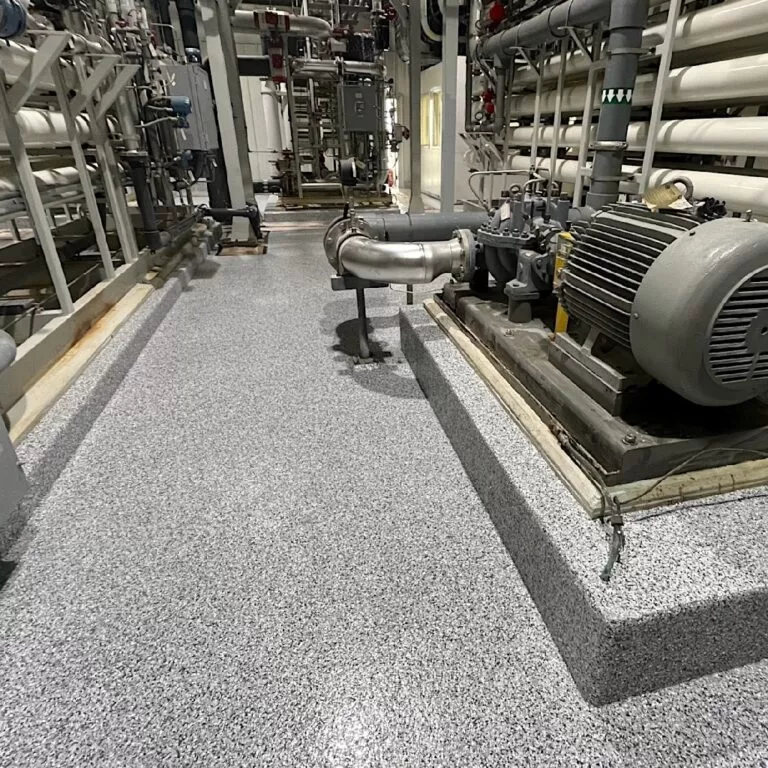
Some operators assume that bare concrete is a simple, durable baseline that avoids the problems of tile and vinyl. In a commercial kitchen, this assumption is incorrect. Concrete is highly porous in its untreated state. It absorbs grease, fats, cooking oils, and the moisture that carries bacteria into the surface structure. Untreated concrete cannot be adequately cleaned to meet health inspection standards, and it cannot resist the chemical sanitizers applied to it during routine cleaning.
Concrete also dusts under traffic, creating particles that contaminate food preparation areas. It provides no slip resistance unless treated, and those treatments are surface applications that wear away. Any commercial kitchen operating on untreated concrete is operating with a floor that fails health standards on multiple grounds.
How Does Epoxy Address All of These Problems?
Epoxy and urethane resin systems solve the problems that tile, vinyl, and bare concrete all create in different ways. The seamless installation eliminates grout joints and vinyl seams, removing the pathways for bacterial accumulation and moisture intrusion. The non-porous cured surface resists absorption of grease, fats, bacteria, and moisture. The chemical formulation withstands the sanitizers and degreasers used in professional kitchens without degrading the surface. And the broadcast aggregate embedded in the slurry phase creates built-in slip resistance that doesn’t wear away.
For operators researching commercial kitchen flooring NJ solutions that genuinely address every one of these performance requirements, professionally installed epoxy systems from an experienced contractor meet the standard that tile, vinyl, and concrete simply can’t consistently achieve. HPS Flooring has been demonstrating this in commercial kitchens across the region since 1988.
Is Epoxy More Expensive Than the Alternatives?
The upfront installation cost of an epoxy system is generally higher than tile or vinyl. That’s a straightforward fact. The relevant question isn’t which option costs more on day one. It’s which option costs less over five, ten, and fifteen years of actual use in a commercial kitchen environment.
When you factor in regrouting costs, tile replacement, vinyl seam repair, the labor time to clean grout-filled joints versus a seamless epoxy surface, and the downtime cost of unplanned floor repairs, the total cost of ownership for epoxy consistently compares favorably against tile and vinyl over a realistic service life. HPS Flooring’s free consultation helps kitchen operators work through this comparison for their specific situation.
Conclusion
The comparison between epoxy, tile, vinyl, and concrete in a commercial kitchen environment isn’t particularly close when you evaluate performance honestly. Tile fails at the grout. Vinyl fails at the seams and under thermal and chemical stress. Concrete fails on porosity and cleanability. Epoxy, properly installed by experienced professionals, addresses every one of these failure points with a single system that’s seamless, chemically resistant, slip-resistant, and built to last for years under real commercial kitchen conditions.
FAQ
Why do grout joints cause problems in commercial kitchens? Grout is porous and absorbs bacteria, grease, and moisture. Under thermal stress, it cracks, allowing moisture to reach the substrate and compromising tile adhesion. A seamless epoxy surface eliminates this vulnerability entirely.
Can vinyl sheet flooring meet commercial kitchen health standards? Vinyl sheet flooring typically doesn’t hold up under the thermal, chemical, and heavy traffic conditions of a commercial kitchen. Its seams degrade over time, creating the same moisture intrusion problems as grout joints in tile.
Does epoxy cost more than tile or vinyl upfront? Yes, the initial installation cost is higher. However, reduced maintenance costs, longer service life, and eliminated repair downtime make epoxy more cost-effective than tile or vinyl over a realistic commercial kitchen service life.